 Shop CurveAndVerve
1. A Moment of Chaos—and Clarity
Several years ago, chaos was my default setting—not just in my home, but in my mind, my relationships, and my routines. I found myself surrounded—literally and emotionally—by piles. Piles of paper. Piles of thoughts, regrets, open browser tabs, and unfinished ideas. I was desperate for something—anything—that felt grounding.
Somewhere in that mental and physical mess, I stumbled upon a random audiobook at the library. I couldn’t tell you the title today if you bribed me with a lifetime supply of coffee. But it offered something far more valuable: a lifeline.
This book proposed something that made perfect sense to my overwhelmed, foggy brain: decluttering your physical space could spark a ripple effect of clarity throughout your entire life—not just your home, but your mind, your schedule, and your emotions.
It wasn’t poetic fluff—it was a grounded, practical framework rooted in behavioral psychology. And just like that, I started decluttering my life, one junk drawer and limiting belief at a time.
(Full disclosure: the junk drawer is still a work in progress. We’re not here to chase perfection.)
Later, learning about the psychology of marketing reinforced that core insight from a totally different angle: what we’re exposed to… shapes us. What if we could flip the script? What if the same principles that marketers use to influence behavior—like cognitive biases—could be applied intentionally to curate a better life?
Take the mere exposure effect, for example. First explored in the 19th century and made famous by psychologist Robert Zajonc in the 1960s, it shows that the more we’re exposed to something, the more we tend to like it—even if we didn’t like it at first¹.
If that’s true, then everything we surround ourselves with—the colors on our walls, the music we play, the books on our shelves—is influencing us already. Why not make that influence intentional? Could a curated space nudge us toward clarity, calm, and connection?
Things really started to click when I came across the work of Dr. Daniel J. Siegel. His theory of integration, and work on mindsight and neuroplasticity, gave language and scientific grounding to what I had only begun to sense: that the environments we shape—and what we choose to pay attention to—can deeply influence our internal world.
He introduced the concept of integration: the idea that our well-being improves when the different parts of us (our thoughts, emotions, body, and relationships) are linked in harmony. His research showed that through positive attention to focused energy and informational flow—what we choose to notice, what we expose ourselves to—we can help rewire the brain². This process, made possible through neuroplasticity³, allows us to reshape our mental patterns and emotional habits over time. Using what he calls mindsight, we can become more aware of our inner world and more connected to others.
Suddenly, curating a peaceful space wasn’t just about aesthetics—it became a gentle but powerful way to support healing, clarity, and connection from the inside out.
Let’s unpack why clutter affects us so deeply—and how curating your space (and what you expose yourself to) can be one of the most profound acts of self-care you’ll ever do.
2. What Is Clutter, Really?
Clutter isn’t just stuff. It’s symbolism. It’s emotional residue. It’s the pile of unsorted mail whispering, “You’re behind.” It’s the jeans from five sizes ago that quietly mutter, “Remember who you used to be?”
According to psychology researchers, clutter is often a physical manifestation of emotional overwhelm, avoidance, or unresolved grief⁴. It’s the outer layer of an inner storm. And it usually doesn’t show up in just one form.
We tend to experience clutter in at least three ways:
- Physical clutter: overflowing drawers, mismatched socks, that box of wires you’ll definitely need someday.
- Digital clutter: 7,000 unread emails, 45 open browser tabs, a desktop wallpaper that hasn’t seen daylight in years.
- Mental clutter: racing thoughts, endless to-do lists, background anxieties that hum like a forgotten appliance.
What these all have in common is this: deferred decisions.
Each unmade choice—what to keep, what to delete, what to do—sits quietly, adding invisible weight to your day. They don’t shout, but they do hum. And over time, that hum turns into a roar.
It’s not about being messy or disorganized. Clutter is often how we cope—with transition, with memory, with fear, with the deep discomfort of letting go.
And for many of us, it starts with the best of intentions. We hold on because something might be useful. Because it reminds us of someone. Because it feels safer to delay the decision than to face the discomfort of making it.
But clutter doesn’t stay quiet forever. Eventually, it starts speaking louder than the life we want to live.
3. Why Clutter Hurts
You’re not imagining it—your clutter really is stressing you out. And it’s not just because of the mess itself. It’s what the mess means, what it reminds you of, and how your brain responds to it.
🧠 The Science Bit (Don’t Worry, It’s Friendly)
According to research, cluttered spaces increase the production of cortisol, our stress hormone—especially in women⁵. When the brain is overwhelmed by visual stimuli—think piles of mail, tangled cords, clothes with uncertain fates—it has a harder time filtering information, switching between tasks, and making decisions⁶.
It’s not just annoying. It’s taxing.
😵💫 Cognitive Overload & Decision Fatigue
Every item in your space that hasn’t been dealt with is a decision waiting to happen. That stack of unread mail? A dozen micro-decisions. The overflowing closet? A battleground of past identities and future maybes. Our brains treat each one like a tab left open—and too many tabs? Hello, system crash.
😔 Emotional Drain
Clutter has a sneaky way of echoing back your inner doubts.
- That half-finished project might whisper, You never finish anything.
- The dusty treadmill says, Remember when you thought you’d use me?
- The gifted item you hate? You’re too guilty to let go of this, aren’t you?
Even when we don’t consciously hear these messages, they hum in the background, draining emotional energy. And over time, this subtle stress adds up.
🧍♀️ It’s Not Just “Stuff”
Clutter is emotionally loud. It reminds us of unfinished business, past versions of ourselves, and the pressure to get our lives together. And because we’re emotional creatures—not robots—it’s easy to get stuck in patterns like:
- Procrastination paralysis: If I can’t do it right, I won’t do it at all.
- Sentimental attachment: Grandma’s teacups might be shoved in a cabinet, but the guilt is front and center.
- Fear of scarcity: What if I need this someday?
Here’s the truth: most clutter isn’t about laziness—it’s about emotion. And recognizing that is the first kind and honest step toward change.
4. The Emotional Roots of Clutter
If clutter were just a logistical issue, we’d all be tidy by now.
But it’s not.
Clutter has roots—deep, emotional ones. It clings to our guilt, our grief, our what-ifs, and our just-in-cases. So before we beat ourselves up for the overflowing drawers or that “storage chair” in the bedroom (we all have one), let’s get honest about what’s really going on.
💔 Sentimental Attachments
Letting go can feel like betrayal. That college hoodie? It holds memories. That chipped mug from your grandmother? It might as well be a love letter. Our brains treat emotionally charged items like extensions of identity and memory. So we hesitate, even when they no longer serve us.
Remember: memories live in you, not just in your things.
🧃 Scarcity Mindset
We keep things we don’t need just in case—just in case we lose the job, just in case the apocalypse hits—and suddenly that broken coffee grinder becomes essential. This fear often stems from past experiences of not having enough, or from growing up in environments where resources were scarce.
It’s valid. It’s human. But it’s not always helpful.
⏳ Perfectionism & Procrastination
You want to declutter… perfectly. You wait for the “right time” to do the whole room, organize everything, and label it with Pinterest-worthy precision. Until then, you avoid it altogether—and the piles multiply.
Truth is, perfectionism is procrastination in a really cute outfit. The real flex? Progress.
🧠 Emotional Avoidance
Sometimes clutter is safer than clarity. As long as the garage is full, we don’t have to deal with the grief stored in those boxes. As long as our schedules are jammed, we don’t have to face the stillness we’re secretly scared of.
Clutter becomes a buffer—a distraction. A shield.
🧷 None of this makes you broken. It makes you human.
The goal isn’t ruthless minimalism or aesthetic perfection. The goal is to understand our relationship with clutter so we can finally change it—with empathy, not shame.
5. The Psychology of Exposure: What You See Shapes Who You Become
So far, we’ve explored how clutter doesn’t just sit in your space—it sits in your psyche. But there’s another side to the coin: what you’re surrounded by shapes you, too. And not just the cluttery parts—the curated ones.
This idea clicked for me not in a therapy session or a psychology textbook, but while learning about marketing.
🛍️ The Marketer’s Trick (That’s Not Really a Trick)
Marketers don’t rely on logic to make you buy things. They rely on exposure. One of the most powerful tools in their toolbox? A cognitive bias called the mere exposure effect.
It’s simple:
The more often we’re exposed to something, the more we tend to like it—even if we didn’t like it at first.
You see the ad. Then again. Then again. Suddenly you’re into oat milk lattes and listening to lo-fi jazz in your oversized sweatshirt.
It’s not manipulation—it’s psychology.
And here’s the twist: we can use this on ourselves.
🪞Intentional Exposure = Internal Transformation
If what we see repeatedly shapes what we like, what we choose, and even how we feel—then that gives us incredible agency. We’re not at the mercy of our environment. We are co-creators of it.
Every room, playlist, and desktop background becomes an invitation to shift—gently and repeatedly—toward what we want more of.
- Want more peace? Expose yourself to peaceful imagery, sounds, and textures.
- Want to feel grounded? Surround yourself with earthy tones, cozy corners, and slow rituals.
- Want to reinforce a growth mindset? Put affirming messages where you’ll see them often.
This isn’t about aesthetic performance. It’s about psychological reinforcement.
“Neurons that fire together wire together.” – Dr. Donald Hebb, neuropsychologist
Your environment is either reinforcing old loops… or rewiring new ones.
6. Integration, Mindsight, and the Science of Rewiring
The connection between our physical space and our mental state isn’t just a poetic metaphor—it’s neuroscience.
Things really started to click when I came across the work of Dr. Daniel J. Siegel, a clinical professor of psychiatry and a pioneer in Interpersonal Neurobiology. His theory of integration gave language and scientific weight to what I’d been sensing all along: that the environments we shape—and what we choose to pay attention to—can reshape us in return.
🧠 What Is Integration?
Integration is the process of linking different parts of a system so they work together in harmony. In Dr. Siegel’s framework, that system is you—your thoughts, your emotions, your body, your relationships.
When these parts are disconnected, we experience chaos, rigidity, or emotional distress.
When they’re linked, we get flow. Flexibility. Clarity. Healing.
In other words, integration is the opposite of inner clutter.
He identifies nine domains of integration (like memory, narrative, consciousness, and relationships), but the big idea is this:
“Well-being emerges when we cultivate the ability to connect differentiated parts—within ourselves and between ourselves and others.” – Dr. Daniel J. Siegel³
🔁 Rewiring Through Intentional Attention
Dr. Siegel’s research also connects to neuroplasticity—the brain’s ability to change itself based on what we experience and focus on.
He explains that by directing positive attention to focused energy and informational flow—in simple terms, what we choose to notice and how we respond—we can literally rewire the brain over time. This is how old emotional habits begin to loosen, and new patterns can take root.
🧘🏽♀️ The Tool: Mindsight
Mindsight is Siegel’s term for our capacity to observe and understand our own minds. It’s how we notice:
- “Oh, I’m getting tense right now.”
- “That cluttered corner is making me feel anxious.”
- “I need to slow down.”
With mindsight, we step back from autopilot and choose curiosity over self-criticism. It’s like zooming out just enough to see the whole picture—and gently guide ourselves back into balance.
Suddenly, that small act of clearing a counter or lighting a candle isn’t trivial.
It’s integration in action.
When we clear space intentionally, we’re not just tidying.
We’re tuning ourselves.
7. How to Start—Decluttering as a Healing Ritual
Decluttering isn’t just a chore. Done with intention, it can become a deeply healing ritual—not about achieving perfection, but about creating space—physically, mentally, and emotionally—for the life you actually want to live.
This is about unburdening, not upgrading.
🔹 Start with One Small, Honest Space
Forget the garage. Don’t start with your entire closet. Choose something small and manageable—a drawer, a bedside table, even just your desktop.
Pick a space that:
- You interact with daily
- Feels like it’s “talking back” to you with stress
- Won’t take more than 15–30 minutes
This gives you an early win. And early wins build momentum.
Bonus tip: Put on music you love, light a candle, and frame it as a ritual—not a task.
🔹 Ask the Right Questions
As you move through your space, don’t just ask:
“Do I need this?”
Ask:
- “Does this support the person I’m becoming?”
- “Am I keeping this out of guilt, fear, or hope?”
- “Would I buy this again today?”
These questions shift decluttering from logistical to transformational.
🔹 Sort into 3 Categories
- Keep with joy – items that serve you now or make your life better
- Let go with gratitude – items from a past version of yourself that no longer fit
- Unsure pile – it’s okay to pause; revisit in 30 days
You don’t have to be ruthless. Just be honest.
🔹 Use the “One-In, One-Out” Rule
Every time you bring something new into your space, something else must leave.
This keeps the inflow and outflow in balance—like a healthy ecosystem. (Also known as the anti-hoarder’s mantra.)
🔹 Revisit Regularly—But Gently
Decluttering isn’t a one-time event. It’s a rhythm. A conversation with your evolving self.
Set a recurring time to check in with your space:
🗓 Monthly “reset” Sundays?
🧺 Five-minute “reset” before bed each night?
Whatever works for you. The key is consistency, not intensity.
8. Designing for Healing: Creating an Environment That Supports You
Once the clutter is cleared, the real magic begins: the intentional act of curation. This is where your space becomes a soft place to land—not just a container for your life, but a co-pilot in your healing and growth.
It’s not about following design trends. It’s about designing a space that reflects the life you want to live—and gently nudges you in that direction every day.
🎨 Use Color to Calm or Energize (On Purpose)
Color doesn’t just sit on your walls—it speaks to your nervous system.
- Soft greens & blues = calming, regulating (think: nature, open sky, peace)
- Warm neutrals = cozy, grounding (think: honey light, aged wood)
- Bold hues (sparingly) = energizing focal points (think: saffron, coral)
You don’t need a perfect palette. You need a palette that feels like home to your nervous system.
💡 Let There Be (the Right Kind of) Light
Lighting impacts mood more than most people realize.
- Natural light boosts serotonin and supports healthy circadian rhythms
- Layered lighting (overhead + lamp + ambient) offers flexibility for different needs
- Warm light in the evening signals your body to wind down
Consider where you spend the most time and ask:
“Does the light here support how I want to feel?”
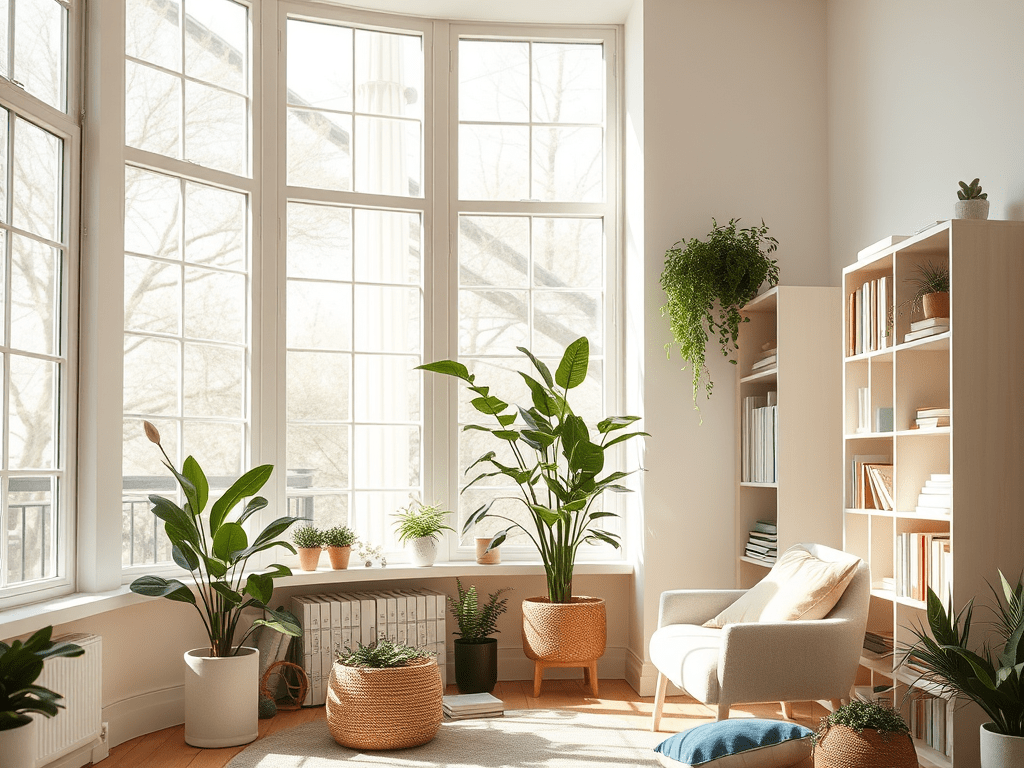
🪴 Bring Nature Indoors
Indoor plants do more than decorate. They:
- Purify air
- Reduce stress
- Remind you that growth is slow, steady, and beautiful
Even a single plant on a desk can shift the energy of a room.
Low-maintenance favorites: pothos, snake plant, ZZ plant, peace lily
📦 Give Everything a Soft-Landing Spot
Clutter creeps back when things don’t have a home.
- Use trays, baskets, drawer organizers—not for perfection, but for ease
- Label if it helps. Color-code if it excites you. But above all, make things findable
You’re not organizing for Pinterest. You’re organizing for peace.
🖼️ Surround Yourself with Meaningful Visual Cues
What you see often… shapes what you believe.
- Art that evokes your values
- Quotes that soothe or strengthen you
- Objects that remind you of where you’ve been—or where you’re headed
This is where that mere exposure effect becomes your secret ally. Expose yourself to calm, to beauty, to hope—and watch how you begin to embody it.
✨ Embrace Senses Beyond Sight
A healing environment isn’t just visual. It’s multi-sensory.
- Sound: Soft playlists, white noise, nature tracks
- Scent: Candles, diffusers, fresh herbs (lavender, eucalyptus, citrus)
- Texture: Layered blankets, natural fibers, worn-in woods, plush rugs
Create moments of tactile comfort—things your body sinks into.
By designing for well-being, you’re not just creating a prettier space—you’re inviting in safety, creativity, focus, and joy.
“You are the curator of your inner and outer world. The more aligned they are, the more at home you’ll feel—in your space and in yourself.”
9. The Mind-Environment Loop: Why Your Space Shapes You Back
If your space feels chaotic, draining, or “off,” it’s not just in your head. It is your head—at least, it’s influencing it more than you might realize.
Our environments don’t just reflect our inner world—they interact with it. Constantly. That’s because your brain is always absorbing input from your surroundings, whether you realize it or not. And what you’re exposed to repeatedly? That shapes you.
🧠 The Mere Exposure Effect: Familiarity Breeds Affection
In psychology, this phenomenon is called the mere exposure effect: the more we’re exposed to something, the more likely we are to prefer it—whether it’s a face, a word, a sound, or a shape¹.
First studied in the late 1800s and later popularized by psychologist Robert Zajonc, the mere exposure effect revealed something simple but powerful: familiarity influences our feelings. While marketing later adopted this concept to shape consumer behavior, its origins lie in cognitive psychology and emotional response research.
And here’s the real magic: we can use this same principle intentionally in our homes.
- See calming imagery daily → start to feel calmer
- See clutter and chaos daily → reinforce internal stress
- Surround yourself with beauty and meaning → feel more grounded, more you
The question isn’t if your environment is influencing you. It’s how intentionally it’s doing so.
🧠 Neuroplasticity: Your Brain Is Listening
Thanks to neuroplasticity, your brain is constantly rewiring itself based on what you do, what you focus on, and yes—what you surround yourself with².
That means:
- Repetition strengthens patterns.
- Positive attention creates new possibilities.
- A consciously curated space can help shift the way you think, feel, and relate to yourself.
This is what Dr. Daniel Siegel calls integration: when the different parts of us—our thoughts, body sensations, emotions, and relationships—are linked in harmony³. When we live in spaces that support calm, clarity, and connection, we reinforce those internal states.
💡 Your Space Isn’t Just a Backdrop—It’s a Co-Therapist
When your surroundings feel good, they signal safety to your nervous system. That’s not just a vibe—that’s science. In a well-curated space, you may experience:
- Less overstimulation
- More mental clarity
- Improved decision-making
- A felt sense of peace and possibility
- A stronger connection to your values and purpose
Your home, your desk, your favorite nook—they’re not just functional. They’re whispering to your nervous system all day long.
The more intentional that conversation becomes, the more empowered you feel.
You’re not just rearranging furniture.
You’re shaping the story your mind tells itself about who you are—and what’s possible.
🔗 References
- Zajonc, R. B. (1968). Attitudinal effects of mere exposure. Journal of Personality and Social Psychology, 9(2), 1–27.
Wikipedia: Mere Exposure Effect - Doidge, N. (2007). The Brain That Changes Itself: Stories of Personal Triumph from the Frontiers of Brain Science. Penguin Books.
- Siegel, D. J. (2010). Mindsight: The New Science of Personal Transformation. Bantam Books.
Mindsight Institute | Interpersonal Neurobiology Overview

 Curve&Verve – The Verve Journal
Leave a comment