 Shop CurveAndVerve
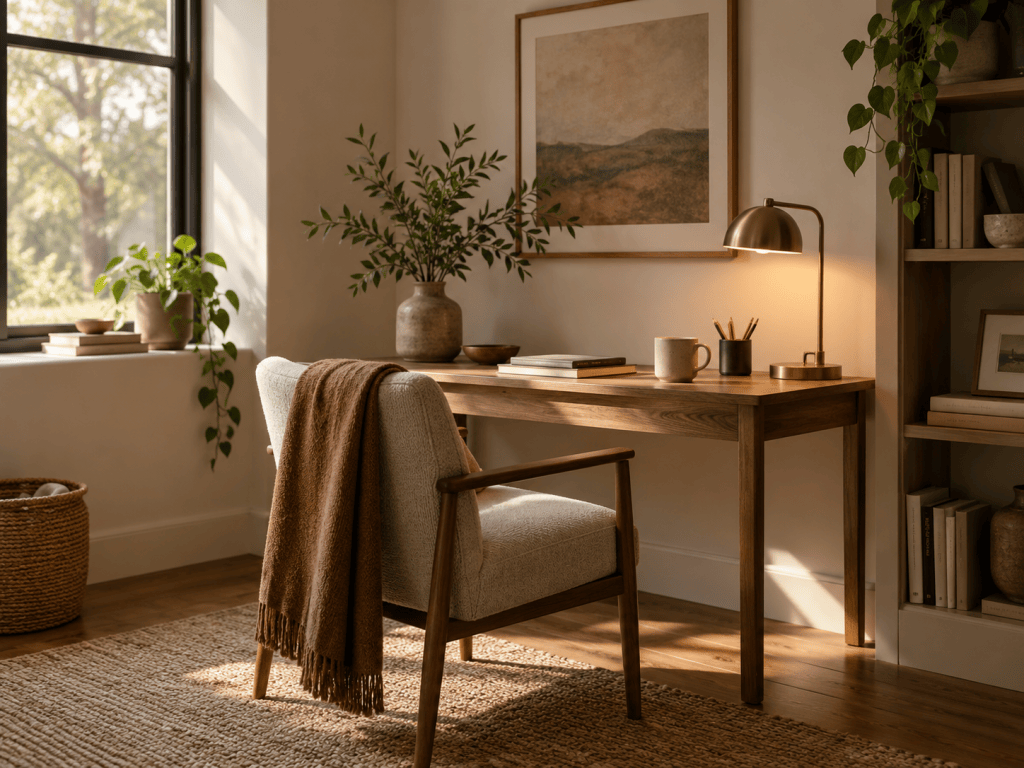
Lately, I have been making small changes to my office.
Nothing dramatic. I am not renovating, replacing everything I own, or launching a full scale design intervention. I have simply been softening the space, reducing visual noise, moving a few things around, and paying closer attention to what helps me feel calmer.
It started as a response to stress.
I spend a significant part of my day in that room, and I began noticing how much my environment affected the way I felt in it. But the relationship went both ways.
Some of the visual noise around me was probably a reflection of my own mental noise. When life became busy, things accumulated. Decisions were deferred. Objects landed somewhere because I had not yet decided where they belonged.
The room absorbed some of the state I brought into it.
Then it quietly handed some of it back.
A space can be perfectly functional and still somehow get on your nerves. It can contain everything you need and still make it harder to settle.
So I started editing.
Then, naturally, the editing spread. A corner in another room. A wall that felt too busy. An object that did not need replacing so much as removing. Small changes that made the house feel quieter, cleaner, and easier to live in.
And as the rooms became calmer, something in me responded too.
Not magically. A rearranged shelf does not solve a complicated life.
But our surroundings are part of the environment in which we think, work, rest, recover, connect, and become ourselves.
We shape them.
They shape us back.
There are limits to what I can do. This home is temporary, and major changes are not practical. I have to work with the architecture, the things I already own, and the amount of money and energy I am willing to invest.
Somewhere in the middle of rearranging things for what was probably the hundredth time, I realized how familiar the process felt.
I have been doing some version of this my entire life.
Before I knew what curation was
For the first several years of my childhood, my family lived in a small three bedroom apartment in Sfax, Tunisia.
Like many homes around us at the time, we had a casual sitting room for everyday life and a more formal living room for receiving guests. The latter mostly hosted silence between holidays and visits.
The sitting room was arranged around floor mattresses, a familiar setup in that part of the world. Because there was not another bedroom for the children, that room also became our sleeping space at night.
Later, my parents had custom wooden benches made for the room, adding structure and much needed storage.
The apartment was simple, but it was well coordinated. It felt cared for, familiar, and complete in its own way.
Even our little red Fiat somehow matched.
I did not think of any of that as design.
It was simply home.
At the same time, my parents were building a house a few miles away. I remember watching it emerge slowly.
First the structure.
Then the roof.
Then, eventually, something that could technically be lived in.
We began spending summers there before the house was finished.
It was much larger than our apartment, and this time there would be bedrooms for the children. By any practical measure, that was progress.
But to me, it felt strange.
There was very little furniture. The rooms echoed. The walls were unfinished. I did not know anyone nearby.
I could not understand why we kept leaving the smaller place that felt familiar for this much larger place that did not feel like home.
Eventually, we moved there permanently.
That house represented an enormous sacrifice for my parents. My mother sold jewelry. There were loans. Money was tight, and the house took years to become fully finished.
It was, in many ways, a dream they had worked very hard to build.
From where I stood, though, it sometimes felt like a dream that had gone off script.
Not because the house was larger, or even because it was unfinished. Somewhere between ambition, financial pressure, practical necessity, and time, coherence seemed to disappear.
One need was solved, then another.
The entry and hallway had sky blue tile with a leaf pattern. One small bathroom was green. The larger bathroom was pink from floor to ceiling. The kitchen was white.
It was, visually speaking, committed to diversity.
For years, some walls were still dark cement. The bathroom remained unfinished long enough that we showered with a large opening in the wall where a fixture would eventually be installed. Frogs casually found their way through it.
Nothing says spa experience quite like the possibility of amphibian company.
I slept for a while on a red folding metal bed. Later, I had an old metal bed that had been in the family for years. For a time, I did homework on a plastic table until a family friend gave me a desk.
None of these things were extraordinary on their own.
Together, however, they created a feeling I would recognize much later.
The space functioned, but it did not feel considered as a whole.
Spaces shaped by necessity
Over the years, family circumstances moved me through several homes, each with its own version of scarcity, incompleteness, or adaptation.
Unfinished surfaces. Aging walls. Makeshift solutions. Furniture used because it was available. Rooms shaped around what could be afforded, repaired, inherited, or repurposed.
The addresses changed, but the feeling was remarkably consistent.
I lived in spaces I had very little power to shape.
Eventually, I returned to my family home, where improvements continued slowly. Walls were painted. Furniture was added. Kitchen cabinets were installed. The bathroom was completed.
The house became more finished.
But finished and coherent are not necessarily the same thing.
For much of my early life, the spaces around me were shaped by necessity. Something was bought because it was affordable. Something else was kept because it already existed. A problem appeared, and a solution was inserted.
Very practical. Very understandable. Not always very pretty.
Looking back, the mismatch around me also felt strangely familiar internally.
The rooms were fragmented.
In many ways, so was I.
I did not understand then how much that feeling would eventually matter to me. I only knew what it felt like when the pieces did not quite make sense together.
The first space I chose
Years later, when I had my first place of my own in Los Angeles, I hired an interior designer.
That sentence sounds far more luxurious than the reality. She was just starting out, I did not have much money, and I only hired her to help with the living room and kitchen.
So no, this was not Architectural Digest arriving with a camera crew.
But it changed something for me.
The space still became a collage, only this time it was an intentional one.
And, fittingly, it all started with an extremely uncomfortable but absolutely gorgeous hand painted Moroccan bench I found at a consignment store.
Everything else revolved around it.
Including, unfortunately, comfort.
Apparently I was learning to curate before I had learned that beauty and suffering did not need to coexist.
Again, another mirror.
Still, the pieces made sense together. Colors spoke to each other. Objects had relationships. The room felt considered.
At the same time, I was doing something similar with myself.
I was rebuilding.
That is difficult for me to separate now.
Was I creating a more intentional environment because I was changing internally? Or did learning to shape my environment give me another way to understand the changes happening within me?
Probably both.
Looking back, I think that experience was more therapeutic than decorative.
For the first time, I understood that a space could be shaped deliberately rather than simply inherited.
And once I learned that, I did not need a designer anymore. Not because I suddenly knew all the rules of design. I still do not particularly care about knowing all the rules of design.
I had simply begun learning how to curate.
Curation is not the absence of constraint
My homes changed over the years. My taste changed with them. My resources remained limited.
I rarely had the freedom to start from scratch or buy everything I wanted, so I learned to work differently.
I moved things. I repurposed them. I removed things. I waited.
I made one good decision instead of five mediocre ones.
That last one took me longer to learn than I would like to admit.
I learned that a room can improve dramatically without becoming more expensive. Sometimes a piece needed to be replaced. Sometimes it simply needed to move three feet to the left.
Sometimes the answer was not a new object at all.
It was an empty wall.
That can be surprisingly difficult. We are so conditioned to fill space that leaving something alone can feel almost irresponsible.
But sometimes restraint is the design decision.
Eventually, I began recognizing the same process elsewhere.
My work affects the way I think, but the way I think changes how I approach my work. My habits shape my energy, while my energy influences which habits I can sustain.
My circumstances create constraints. Within those constraints, I make choices. Those choices create possibilities, and sometimes those possibilities change the constraints themselves.
That, to me, is where growth happens.
Not outside constraint.
Inside the relationship between constraint and choice.
I ask some version of the same questions:
What is working? What is creating friction? What can be rearranged?
What am I holding onto simply because it is already here?
What constraint is real?
Where do I still have room to choose?
Curation is not about having unlimited options.
It is about making deliberate choices within the options you actually have.
Edit before you add
Scarcity can teach you to hold onto everything. You never know when something might become useful.
A piece of furniture. A habit. An opportunity. A commitment. A version of yourself.
But curation requires something different.
Discernment.
Sometimes we assume dissatisfaction means something is missing when something simply needs to be edited.
If a room feels uncomfortable, start there. What is creating visual noise? What interrupts the flow? What are you keeping out of habit rather than affection or usefulness?
What can be moved, repurposed, softened, or removed before you buy anything else?
Then identify the real constraint.
Maybe your budget is limited. Maybe the room is small. Maybe there are structural features you cannot change. Maybe the space is temporary.
Maybe you share it with someone whose taste is entirely different from yours.
A separate essay could probably be written about that last one.
A constraint does not mean there are no choices.
It means the choices need to become more intentional.
Start with how you want to feel
One of the most useful questions I have started asking is also one of the simplest:
How do I want to feel in this space?
Calm. Focused. Rested. Energized. Comfortable. Welcomed.
The answer changes what matters.
If I want calm, reducing visual clutter may matter more than adding another decorative object. If I want warmth, lighting may matter more than furniture. If I want focus, the desk itself may matter less than what surrounds it.
And then comes the question on the other side:
What am I bringing into this room?
Am I expecting my surroundings to create calm while I continue filling every surface? Am I trying to create focus without addressing the habits fragmenting my attention?
A beautiful environment cannot do all the work for us.
But neither is it irrelevant.
How a space affects you is part of what the space does. And how you inhabit it becomes part of what the space is.
The same questions work elsewhere
The more I think about it, the less I believe curation belongs only to interiors.
What is creating friction in my schedule? What am I doing simply because I have always done it? What needs to be removed before I add another responsibility?
Which parts of my career still fit? What resources am I underusing? Which limitation is truly fixed, and which one have I simply stopped questioning?
We often imagine improvement as accumulation.
More money. More time. More space. More credentials. More furniture. More options.
More everything, apparently.
Sometimes those things help.
But more does not automatically create coherence.
And acquisition is not the same thing as creation.
Having less was not always the problem.
The problem was when the pieces stopped making sense together.
Making something livable
I used to think creating a beautiful space required better circumstances. More money. More permanence. The ability to replace what I disliked. Complete freedom to choose.
Now I think it often begins somewhere much smaller.
With attention. With noticing what creates friction. With understanding what you actually need. With deciding what belongs and what does not.
With recognizing what you are bringing into the space yourself.
And with using the resources you already have more deliberately.
My relationship with space is still evolving.
So am I.
I still make mistakes. I still buy something and later realize it is wrong. I still move objects from room to room. I still have budgets, limitations, features I cannot change, and compromises I have to make.
And yes, I still occasionally stare at a wall as if it has personally offended me.
But I no longer believe constraints have to determine the entire experience.
Nor do I believe changing the environment alone changes everything.
The relationship is more interesting than that.
We shape our spaces.
Our spaces shape us.
Life introduces constraints, resources, interruptions, opportunities, people, and circumstances in between. And within all of that, we keep making choices.
Curation, for me, is not the pursuit of a perfect environment.
It is the practice of creating greater coherence within an imperfect one.
Sometimes that means changing a room. Sometimes it means changing the way I work. Sometimes it means changing myself.
Usually, if I am paying attention, each one changes the others.
Edit.
Rearrange.
Keep what serves.
Release what does not.
Refine from there.


Leave a Reply